Memory Beneath the Sand
On 28 May 2026, the French National Assembly adopted a bill repealing the Code Noir and other texts that organised slavery in French colonies. This late repeal erases neither the crimes nor the inherited racial hierarchies, but it recalls a truth states like to postpone: old texts do not die by themselves. Faced with colonial silences, feminist memories and the engraved stones of the Sahara, African heritage ceases to be scenery. It becomes evidence.
The point must be stated precisely: a law repealing a symbolic text does not abolish slavery retroactively, does not repair colonisation and does not erase the forms of racism that outlived their legal frameworks. It says something else. It shows that a state can abolish an institution, multiply memorial gestures and still keep, for a long time in its archives, the vocabulary that made that institution administrable.
That gap is the real subject. The memory of slavery cannot be reduced to a ceremony, a plaque or a law. It begins in the words that classified bodies, in the registers that counted lives as property, in the silences that pushed certain suffering outside the national narrative. When a parliament returns to the Code Noir, it is not merely reopening an old legal file. It is admitting, belatedly, that the libraries of power still contain active ghosts. It also signals that the issue no longer lies only in metropolitan texts, but in the way concerned societies, in Africa and in the diasporas, reread their own traces.
What the texts do not say
Official memory likes clean dates. It likes abolition because it allows a sentence to end. It likes monuments because they immobilise pain in stone. But slavery was never only a matter of texts. It was also an organisation of descent, torn motherhoods, lost names, displaced languages, female bodies delivered to a double domination: productive, sexual and domestic.
This is where feminist readings become decisive. Not because they add a sensitive note to a history already written, but because they shift the very question of the archive. Who left a trace? Who was counted? Who was named? Who appears as a subject, and who remains a mass, cargo, servant, concubine, captive, womb, arm? Feminist memory of slavery does not merely demand a place in the story. It contests the architecture of that story, forcing us to reread inventories, travel accounts, broken genealogies, songs, gestures of care and oral transmissions.
It reminds us that women did not only undergo history. They carried it, transmitted it, sometimes hid it in order to survive, and spoke it differently when the master’s writing made the law. From this perspective, heritage is not an object to be admired behind glass. It is the place where the right to name the dead and the living is disputed, where sexual, domestic and economic violence, often minimised by official archives, can finally be articulated.
The Sahara against the idea of emptiness
The Sahara enters here as a major contradiction. It has too often been described as empty, as a natural frontier, as a mute immensity. That image suits power. An empty desert does not speak. It does not testify to circulations, caravans, conflicts, slave trades, refuges, crossings, languages or knowledge. It becomes a surface to cross, not an archive to hear.
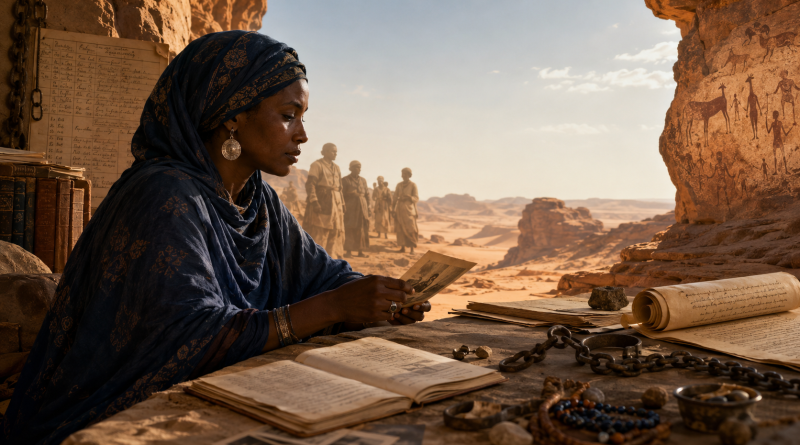
Yet the archaeological Sahara contradicts this laziness. Tassili n’Ajjer, in Algeria, inscribed on UNESCO’s World Heritage List, contains more than 15,000 rock drawings and engravings which, according to the organisation, make it possible to follow climatic changes, animal migrations and the evolution of human life on the edge of the Sahara from 6000 BCE to the first centuries of our era. These images do not speak directly of all later crimes, but they destroy one fiction: that of a Sahara without depth, without memory, without a civilisation of its own.
That depth matters politically. It prevents Africa from being reduced to the scene of its capture. It recalls that before the slave trade, during it and after it, societies produced forms, signs, narratives, techniques and cosmologies. Slavery tore human beings away from worlds that existed. Colonisation then claimed to discover, classify, preserve and sometimes confiscate the traces of those worlds.
Saharan heritage is therefore caught in a double trap: to be folklorised as a tourist treasure or neutralised as a scientific object without people. In both cases, stone is separated from living memory. The engravings are contemplated, while the heirs, the languages and the contemporary struggles over access, restitution, protection and narrative are forgotten.
Routes and silences
UNESCO launched in 1994 the programme now known as Routes of Enslaved Peoples to break the silence surrounding the history of slavery and the slave trades. In 2024, the organisation integrated the first sites into a network of places of history and memory linked to enslavement and the slave trade. This approach matters, but it raises a demanding question: who holds the map?
Mapping memory can open paths. It can also reproduce hierarchies if the recognised sites remain those institutions already know how to see. Atlantic ports, forts, plantations and European archives obviously have their place. But inland Africa, trans-Saharan routes, domestic memories, women’s narratives, minoritised languages and sites without spectacular monumentality must not remain on the margins of the system.
The memory of slavery needs a broader geography. It must hold together the Atlantic, the Mediterranean, the Sahara, the Indian Ocean and the internal routes of the continent. It must avoid two symmetrical traps: minimising European responsibility in the name of African complexity, or erasing internal and trans-Saharan trades in order to keep only a moral face-off between Europe and the Americas. Complexity must not serve as an excuse. It must serve as a demand.
This is where cultural writing becomes political. To tell heritage is not to decorate history. It is to decide which traces count as evidence, which pains become public, which voices remain assigned to folklore. The memory of slavery does not need compassion without consequence. It needs institutions that open archives, schools that teach without mutilating, museums that do not confuse preservation with possession, research that hears oral inheritances, and public policies that connect memory, racism, repair and social justice.
A counter-archive at human scale
African heritage is not only what has been saved from time. It is also what survived looting, colonial classifications, overly narrow national narratives and organised forgetting. The memory of slavery, feminist voices and Saharan stones do not tell the same story, but they pose the same question: who has the right to write the past of others?
A law can repeal a text. It cannot, alone, repair the order of the gaze. For that, the centre must be displaced. Africa must no longer be viewed only from imperial archives. Women must no longer be treated as annexes of memory. The Sahara must no longer be turned into a background map. We must listen to songs, names, stones, scars, languages and absences.
Memory does not sleep beneath the sand. It only waits for us to stop calling silence what we never wanted to hear.
Lila Tazrout
Sources used
- French National Assembly: legislative file on the bill repealing the Code Noir, text adopted on 28 May 2026.
- UNESCO: Routes of Enslaved Peoples programme, launched in 1994.
- UNESCO: network of places of history and memory linked to slavery and the slave trade, first sites integrated in 2024.
- UNESCO: World Heritage file on Tassili n’Ajjer.
- Le Monde: explanatory video on the French vote repealing the Code Noir, 28 May 2026.
- LCP: session on the repeal of the Code Noir, 28 May 2026.