When Health Begins at Home
The Ebola outbreak in the Democratic Republic of Congo and Uganda, the intensification of heatwaves and the fragility of popular housing point to the same reality: health crises rarely begin in hospitals. They first settle into homes, schools, transport, badly ventilated rooms and families forced to compensate for what public services no longer guarantee.
On 17 May 2026, the World Health Organization declared that the Ebola outbreak in the Democratic Republic of Congo and Uganda constituted a public health emergency of international concern. By 28 May, Reuters was reporting 1,077 suspected cases, including 121 confirmed, as well as 246 suspected deaths, including 17 confirmed in the DRC; Uganda had recorded eight confirmed cases. A few days later, Reuters also reported, citing Africa CDC, that funding pledges for the response had fallen from about $500 million to about $290 million. The message is brutal: at the very moment when a crisis requires continuity, pledged money becomes uncertain.
This is not only a medical file. Ebola forces us to look at health as a social relationship. The virus does not move through a vacuum. It crosses roads, mourning rituals, markets, families, beliefs, fears and care structures of unequal solidity. The response also collides with ordinary but decisive constraints: access to affected areas, restricted flights, movement of teams and supplies, trust in institutions. In this type of crisis, a laboratory is not enough. Without local workers, community relays, clear explanation and dignified care, public health action runs into rumor, fatigue and distrust. The epidemic then reveals what systems like to hide: a population cannot be protected by communiqués alone.
Families on the front line
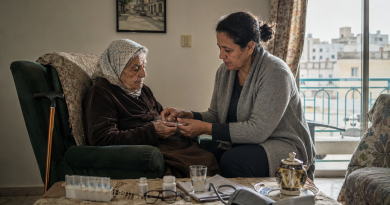
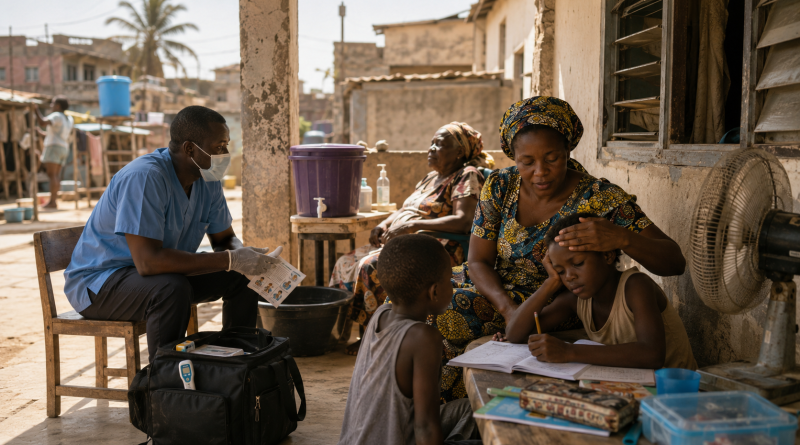
In many African societies, the family remains the first place of care. It accompanies the sick, looks after children, finds transport money, buys missing medicines, negotiates with the school, watches over elders and absorbs absences and lost income. This role is often celebrated as solidarity. It is rarely named for what it becomes when public services weaken: a silent transfer of burden.
When an epidemic breaks out, when heat becomes dangerous, when housing no longer protects, when a school lacks water or ventilation, households improvise. A mother keeps a feverish child at home without knowing whether she should go to a health centre. A father avoids losing a day of work because the consultation is already too expensive. A grandmother sleeps in an overheated room because the house cannot breathe. A child arrives in class tired, dehydrated, unable to follow. The family does not merely replace the state: it also absorbs the costs of transport, water, ventilation, care, medicine, absence from work and administrative time. The health crisis does not begin with the ambulance. It begins with those tiny choices that wear down the poor.
Heat makes this mechanism more visible. WHO reminds us that heat stress is a major health risk: it aggravates cardiovascular, respiratory, metabolic and mental health conditions in particular, and can cause fatal heatstroke. This is not abstract. It changes the meaning of housing. A badly oriented room, a metal roof, the absence of trees, lack of water, the impossibility of ventilation become health factors. A wall is no longer just a wall. It becomes a boundary between protection and exposure.
WHO also notes that the temperature felt in the sun can be 10 to 15°C higher than the measured temperature. That concretely changes the experience of heat in schoolyards, under sheet-metal roofs, at bus stops, in unventilated workshops and in homes where air does not circulate. Weather reports announce a temperature; families live through a trial. Between the two lie the quality of the built environment, access to water, shade, the possibility of stopping, the right to rest and the ability of an administration to anticipate.
A 2026 study cited in monitoring notes on informal settlements in Nairobi and Dar es Salaam showed that indoor temperatures could exceed outdoor temperatures by 9°C in some homes. The figure must not be mechanically generalized to all working-class neighborhoods in Africa, but it sheds light on a broader reality: the heat experienced by the poor is not the heat of weather bulletins. It is trapped in walls, stored at night and borne by children, older people, the sick and women who spend more time in domestic spaces.
School as shelter or risk
School is often presented as the place of the future. In a health or climate crisis, it becomes above all a test of the present. Does it have drinking water? Are classrooms ventilated? Do teachers know how to recognize heat-related illness? Are health protocols understood by families? Can children stay at home without absence immediately becoming a disciplinary or economic problem?
School can protect. It can spread good practices, detect vulnerabilities, organize information and relieve families. But it can also become an amplifier of vulnerability if it crowds pupils into burning classrooms, if it asks parents to provide what the institution does not, if it turns every crisis into top-down instructions without means. A health policy that forgets school forgets children. A school policy that ignores health forgets why a child learns, or does not learn.
This point goes beyond Ebola. It applies to heatwaves, respiratory diseases, poisoning, access to water and fatigue-related disorders. In working-class districts, school is sometimes the only regular public building in the life of families. That gives it an immense role. But it cannot be asked to serve as shelter, clinic, social centre and place of learning without being given the material means to hold that function.
Housing as health infrastructure
Social housing that is announced, promised or delivered is often treated as a matter of figures: number of units, cost, deadlines, beneficiaries. That is too narrow. Housing is also a health policy. It determines the possibility of sleeping, washing, cooking, isolating, ventilating, studying and caring for a sick person without contaminating the entire home. Overcrowded housing turns illness into an immediate collective matter. Overheated housing turns summer into a physical ordeal. Housing far from services makes every consultation more expensive.
In Tunisia, the government announced in January 2026 a programme of about 5,000 social housing units by 2030, with a first phase of 1,213 units across 11 governorates. The figure matters, but it is not enough. The health impact of such a programme will also depend on thermal quality, access to water, proximity to schools and health centres, transport and the real possibility for families to live in less exposed spaces. The social dimension cannot be measured only by the number of keys handed over. It is measured by what housing actually allows families to do: live better, fall sick less often, protect children, reduce travel and withstand heat without collapsing.
Across the Maghreb, the Sahel and sub-Saharan Africa, authorities like to separate files: health on one side, housing on another, school elsewhere, climate somewhere else. Ordinary life does not recognize these administrative partitions. A poor family experiences all of it at once. The same income pays for transport, medicine, a bottle of water, a fan, rent and a school notebook. The same woman accompanies the sick child, prepares the meal, watches the elder, looks for health information and faces the administration. The same room is used to sleep, study, recover and sometimes provide care.
Community health is not a luxury
Recent crises recall a political obviousness: community health is not a humanitarian option for poor countries. It is a condition of the social state. Local workers, neighborhood associations, district nurses, school relays, health mediators and women’s networks often know before the administration what is really happening. They see absent children, hidden fevers, families giving up care, unbreathable homes, and elderly people isolated during heatwaves.
Yet these actors are too often mobilized during emergencies and then forgotten in budgets. They are asked to alert, translate, convince, reassure and sometimes take risks, without secure status or lasting funding. The result is familiar: during the crisis, the importance of the neighborhood is rediscovered; when budgets are decided, centralization, large facilities and visible announcements return.
The issue is not to oppose hospital and neighborhood. The hospital is indispensable. But it often arrives late in the social chain of illness. Before it, there is water, housing, trust, school, transport, information and a family’s ability to miss work in order to seek care. A public policy that sees only the hospital bed sees the patient too late. A policy that begins with the home, the school and the neighborhood sees society before it breaks.
Ebola, heat, housing and school therefore do not form a scattered list. They draw the same map: the places where families hold, sometimes alone, against risks that are no longer exceptional. The question is not only how many crises our states can manage. It is how long families can continue to serve as the general shock absorber for public systems that arrive after exhaustion.
Samia Aït Salem
Sources used
- WHO: 17 May 2026 statement on the Ebola outbreak in DRC and Uganda.
- WHO: “Heat and health” fact sheet, updated 28 April 2026.
- Reuters: “Funding pledges for Ebola outbreak almost halved, Africa CDC says”, 28 May 2026.
- Reuters: “Kenya approves US Ebola quarantine request as WHO chief heads to Congo”, 28 May 2026.
- IIED: 2026 data on heat effects in some informal African settlements.
- Agence Ecofin: “Tunisia plans 5,000 social housing units under 2026-2030 plan”, 15 January 2026.
- Tunisienumerique: “Tunisia: Construction of 1,213 Housing Units to Begin in 2026 across 11 Governorates”, 14 January 2026.