Building long: from Gaudí to Voyager, the political lesson of time
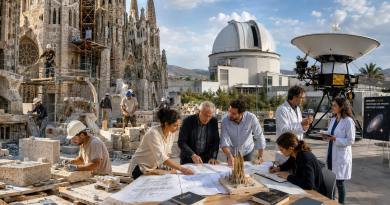
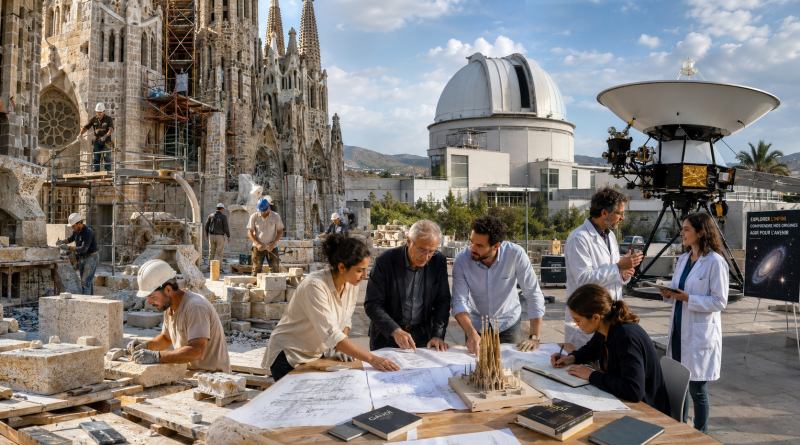
The Sagrada Familia and Voyager seem to belong to two worlds: a stone basilica in Barcelona, a probe launched into space in 1977. Yet they tell the same thing: strong societies know how to build beyond themselves. They entrust time with a work that will survive men, governments and fashions.
There are works that humiliate the present. Not because they are perfect, but because they force societies to measure themselves against long time. The Sagrada Familia, begun in the nineteenth century and continued long after Gaudí’s death, belongs to this category. So does Voyager. Launched in 1977 for a limited mission, the probe continues to transmit data after almost half a century. Stone and space, architecture and engineering, faith and science: two different stories, one same inner discipline.
These works say that a civilization cannot be reduced to what it consumes, announces or inaugurates. It is judged by what it is able to transmit. Gaudí died before the completion of his project. Voyager’s engineers knew their object might outlive them. In both cases, the work does not belong only to its authors. It becomes a chain. Each generation receives a fragment, understands it, corrects it and continues it.
This lesson applies to Algeria. The country suffers from a sick relationship to time. It readily celebrates origins, but struggles to organize continuity. It inaugurates projects, then lets them disappear into procedures. It announces plans, then forgets evaluation. It invokes memory, but too often maintains an impoverished official history. It speaks of science, while locking researchers in underfunded universities. It speaks of youth, but mostly transmits waiting.
Long time is not nostalgia. It is a method. It requires open archives, solid schools, stable institutions, respected professions, monitored budgets, free researchers, trained craftspeople, planned cities, protected sites, living libraries and demanding museums. Above all, it requires one rare thing: accepting that one will not always harvest what one sows.
Here lies perhaps the deepest weakness of the state administered by the short term. It wants to bring everything back to signature, decree, ceremony, mandate and immediate loyalty. But great works escape that temporality. A national library worthy of the name is not built for a political season. An archaeology policy is not judged by a photo of excavation. A university does not become a place of knowledge because a speech has proclaimed it. A rail network, a public school, a national memory or a scientific culture require institutional patience.
The comparison may seem distant. It is not. When a probe built with technology that is now laughably modest continues to speak from the edges of the solar system, it reminds us that intelligence is not only brute power. It lies in precision, sobriety, anticipation, maintenance, documentation, team and transmission. These are qualities our states rarely discuss, because they are not easy to photograph.
When a basilica crosses wars, controversies and generations, it reminds us that heritage is not a frozen décor. It lives through the gestures that continue it. Algeria has a heritage far wider than its official narrative suggests. It possesses historical layers that should nourish an immense collective imagination. They would still need to be treated as common wealth, not as material to be bent to the story of the moment.
To build long is to refuse the politics of erasure. It means saying that a child born today must be able to receive something other than a country exhausted by its own renunciations. It means understanding that modernity does not consist in importing the words of the future, but in creating the material conditions for its arrival. It also means accepting that memory is not docile. Living memory contradicts, nuances, disturbs and enlarges.
Time is an infrastructure. Societies that know it build cathedrals, probes, schools, networks and libraries. Those that forget it multiply announcements and age quickly. Algeria does not need to imagine itself eternal. It needs to become capable of lasting again.
Lila Tazrout
Sources used
- Press : BBC Afrique, article sur Gaudí et la Sagrada Familia.
- Press : BBC Afrique, article sur Voyager.
- Press : Algérie Eco, article sur la création d’un Haut Conseil des scientifiques et d’une Agence nationale d’archéologie.
- Press : MaliActu, article sur les innovations africaines à VivaTech 2026.