Memory Alone Does Not Make a University
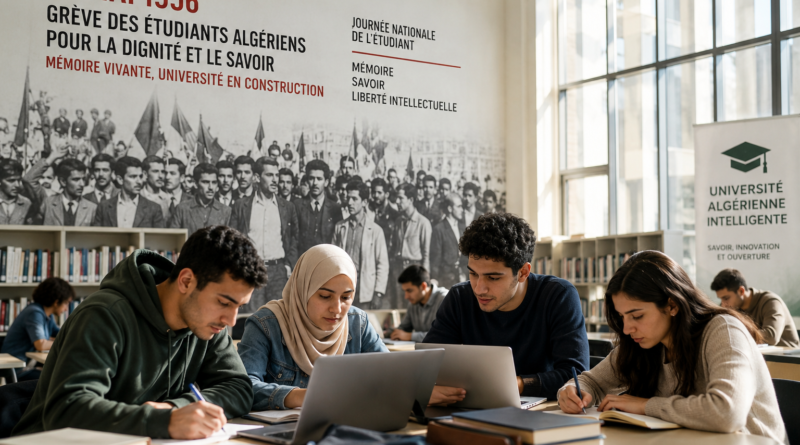
May 19, 1956 belongs to those dates that refuse to become quiet memory. Every year, the commemoration returns with wreaths, speeches, decorated lecture halls and promises of modernization. In 2026, on the seventieth anniversary of the Algerian students’ strike, the initial El Watan article linked the legacy of UGEMA to the horizon of a so-called smart university. The connection is not neutral: it places two versions of the university face to face, one that rebelled against the colonial order and another asked to speak today’s language of performance, platforms and digital systems.
On May 19, 1956, the General Union of Algerian Muslim Students called on Algerian students and high school pupils to leave the benches of the colonial university and join the liberation struggle. The date is now part of national memory as National Student Day. Yet it should not be reduced to a frozen heroic image. The strike was not only a patriotic gesture. It was a break with an institution that trained a small number of colonized bodies without fully recognizing the people to whom they belonged.
Knowledge was not neutral
The strength of May 19, 1956 lies in a simple political intuition: the colonial university was not merely a place of teaching. It was a sorting machine. It distributed titles, selected elites, produced exceptions and asked the colonized person promoted by school to pay for social ascent by separating from their own society. UGEMA’s call broke that contract. It said that knowledge could not be detached from collective dignity.
This is where commemoration becomes difficult. If May 19 is celebrated only as a scene of sacrifice, it becomes manageable. The striking students are turned into noble figures, already politically dead, useful for posters and institutional names. But if their gesture is taken seriously, it forces us to look at today’s university not as a republican façade, but as a field of forces: who enters, who leaves, who speaks, who researches, who decides, who waits?
Algeria has expanded higher education. It has built campuses, multiplied enrolment and opened university access to broader social groups. That matters. It would be dishonest to erase it. But mass access does not automatically produce a living institution. A university can welcome many students while giving them little grip on the world. It can produce diplomas without producing intellectual power. It can commemorate the students of 1956 while keeping the students of today in waiting, obstruction and bureaucracy.
The smart university, or the old problem under a new name
The phrase “smart university” sounds modern. It speaks of digitalization, artificial intelligence, connected management, platforms, skills and employability. None of this is contemptible in itself. A university poor in libraries, slow in procedures, fragile in laboratories and cut off from global scientific networks cannot live on heroic nostalgia. It needs infrastructure, data, access, scientific languages, circulation and tools.
But the risk is familiar: replacing a political question with a technical solution. A university is not smart because it has a platform. It becomes smart when it protects free research, gives teachers time, respects students as subjects rather than files, and treats language, memory, science and work as living materials. Without that, digitalization is only a new layer on an old administrative verticality.
May 19, 1956 reminded us that knowledge can choose its side. In 2026, the issue is not to ask students to repeat the same gesture. History does not return in that way. The issue is what the institution does with their intelligence. Are they invited to think, contest, produce and invent? Or merely to circulate through forms, rankings, platforms, degrees and competitive exams that promise the future while often organizing waiting?
Official memory and active memory
National memory needs dates. But a date can become a wall if it opens no passage. May 19 is not only a war anniversary. It is a question about the relation between knowledge and liberation. What is the value of a university that transmits the memory of those who broke with the colonial order if it does not form minds capable of questioning the orders of the present?
This is not about opposing heroic dead to imperfect living students. That would be too easy. Today’s students do not live in 1956 or in the clandestinity of war. They live under the pressure of unemployment, the devaluation of diplomas, the anxiety of departure, weak laboratories, dependency on foreign publication circuits, career bureaucracy, exhausted teachers and, sometimes, closed spaces of debate. University patriotism cannot mean asking for silence from those who inherit a memory of rupture.
There is a sterile way to celebrate May 19: multiply ceremonies, smooth out contradictions, recite the debt owed to the revolutionary generation, then let the university function as before. There is another, more demanding way: to turn the date into a moral audit of the institution. Not to humiliate the university, but to restore its vocation. A university worthy of this memory must do more than preserve the archive. It must allow the living to write.
A loyalty that disturbs
Loyalty to May 19, 1956 is not measured by the number of speeches delivered. It is measured by the capacity to make the university a place where knowledge is not domesticated. That requires open libraries, funded laboratories, respected teachers, heard students, assumed languages, research less dependent on administrative injunctions, and history that is not only celebrated but worked through.
Algerian memory is often treated as a treasure that simply needs to be guarded. But it is more dangerous than that. It asks questions. It asks why some promises of independence remain unfinished. It reminds us that the students of 1956 did not leave the university because they despised knowledge, but because they wanted to wrest knowledge away from an institution that separated it from freedom.
This is why the phrase “smart university” should not reassure us too quickly. The intelligence Algeria needs is not only digital. It is historical, social, linguistic, scientific and democratic. It does not reside in software. It resides in the possibility of forming minds that do not confuse obedience with knowledge.
May 19, 1956 does not ask to be embalmed. It asks to be continued differently.
Lila Tazrout
Sources used
- Press: El Watan, 18/05/2026, initial article from the LMA archive on May 19, 1956 and the smart university.
- Secondary source: historical synthesis consulted on the 1956 Algerian students’ strike and UGEMA.