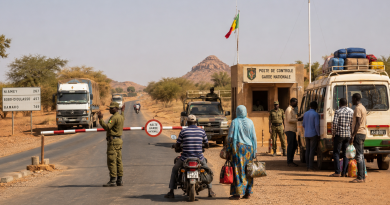

The war of corridors
In Mali, landlocked geography is not a neutral fact. It becomes a political weapon as soon as ports, borders, insurance, currencies and truck convoys enter the regional balance of power.
The article published by MaliActu on May 18, 2026, about “blockade” and the “war of corridors” points to a deeper issue than a transport crisis. Mali is not only facing a logistical problem. It is facing a strategic contradiction: it wants to assert a harder political sovereignty while materially depending on roads, ports and crossings located outside its territory.
This contradiction is not new. All landlocked states know it. But it has become central since the break between the Alliance of Sahel States and ECOWAS. Mali, Burkina Faso and Niger formally left the West African bloc on January 29, 2025. The move was presented as an act of sovereignty. Politically, it was. But geography does not obey communiqués. Goods still have to pass somewhere. Fuel, rice, medicine, spare parts, agricultural inputs and construction materials need ports, roads, customs, banks, insurance and security.
Sovereignty through other people’s ports
Mali can leave an institutional framework. It cannot leave the ocean behind. Bamako remains connected to the world through corridors crossing coastal states: Dakar, Abidjan, Lomé, Conakry, Nouakchott, and sometimes other routes depending on prices, risks and political calculations. Each option is more than a road. It is a dependency relationship.
A corridor is not just a line on a map. It is a chain of decisions. Who controls the port? Who sets the fees? Who secures the trucks? Who opens or slows the border? Who supplies fuel? Who guarantees payment? Who accepts the political risk? Concrete sovereignty is measured through these ordinary questions.
That is why the word “blockade” must be handled carefully. If there is a formal blocking measure, it must be documented. If it is an accumulation of constraints, delays, costs, restrictions, political pressure and security risks, then the word describes a state of logistical strangulation rather than a legal act. In both cases, the political effect is serious: a landlocked country can be weakened without a single soldier crossing its border.
Leaving ECOWAS does not erase the region
The exit from ECOWAS opened a phase of regional reconfiguration. The AES states want to build political and security autonomy. They seek to loosen the grip of regional arrangements they see as aligned with external interests. But this move runs into a material fact: Sahelian economies remain embedded in regional networks built over decades.
ECOWAS can be criticized, bypassed or rejected. Its roads, markets, ports, migrant workers, banks, carriers and interdependencies do not disappear. Politics can proclaim rupture. Trade forces negotiation.
This is why the war of corridors is also a war of mediation. Mali must diversify its access routes so that one port, one neighbour or one diplomatic crisis does not become a chokepoint. Diversification gives breathing space. It reduces immediate vulnerability. But it does not automatically create sovereignty. Using another port often shifts dependency rather than abolishing it.
The Moroccan Atlantic option: solution and influence
The support exPressd in 2025 by AES states for Morocco’s Atlantic access initiative fits this logic. For Bamako, Ouagadougou and Niamey, the idea is clear: multiply exit doors, open a route to the Atlantic, reduce exposure to circuits that have become politically uncertain.
But no infrastructure is innocent. A corridor creates a geography of interests. It installs contracts, technical dependencies, diplomatic priorities, standards, banks, insurance, transport companies, checkpoints and logistics zones. Morocco is not merely proposing a road. It is proposing an anchoring point. For Rabat, Atlantic access toward the Sahel strengthens strategic, economic and diplomatic depth. For Sahelian states, it may provide room for manoeuvre. Both readings are true.
The question is therefore not whether a corridor should be accepted or rejected. The question is: under what conditions? With what investments? What degree of national control? What transparency in contracts? What real cost for importers? What protection for consumers? How will local carriers be included? Without these answers, a corridor presented as liberation can become a new lane of dependency.
The road as a silent battlefield
The Sahel crisis is too often told through military bases, armed groups, drones, coups and security alliances. That is not enough. A state can win a sovereignty discourse and lose the battle of the rice bag. It can expel a foreign army and depend on a foreign port. It can denounce interference and still submit to the law of logistical costs.
The road is a silent battlefield. When a truck takes longer to cross a checkpoint, prices rise. When an insurer considers an axis too risky, prices rise. When a port becomes politically less reliable, prices rise. When a border closes, the domestic market pays. In Sahelian countries, this increase does not remain in trade tables. It reaches popular markets, construction sites, pharmacies, farms and families.
This is the social side of geopolitics. Sovereignty is not measured only by the flag. It is measured by the ability to secure supplies, stabilize prices, protect vital flows and prevent the population from bearing alone the cost of diplomatic ruptures.
What the war of corridors reveals
Mali stands at the centre of a major regional contradiction. It wants to break with an inherited political dependency. Yet it must deal with an immediate geographical dependency. It seeks alternative partners. It cannot invent the sea. It wants to redraw alliances. It must secure roads.
This contradiction does not condemn the sovereignty project. It makes it more demanding. Serious sovereignty does not mean replacing one gate with another, one protector with another, one port with another. It requires a long-term strategy: diversified corridors, strategic stocks, transparent negotiations, public control of costs, stronger national carriers, pragmatic regional cooperation, and secure routes.
This is where the rhetoric of blockade can be useful or dangerous. Useful, if it forces us to see the violence of logistical dependency. Dangerous, if it replaces concrete solutions with denunciation. Mali does not only need to name the strangulation. It needs to build the means not to be delivered to it.
The Sahelian battle is not fought only in the desert, barracks or chancelleries. It is fought in ports, truck parks, border posts, warehouses, banks and markets. Whoever controls the corridor does not control everything. But he often holds tomorrow’s price in his hand.
Mourad Ighil
Sources used
- Press:
- MaliActu, « Mali : le blocus et la guerre des corridors », 18 mai 2026.
- Reuters, « Landlocked Burkina, Mali, Niger back sea access through Morocco », 28 avril 2025.
- Reuters, « West Africa bloc announces formal exit of three junta-led states », 29 janvier 2025.
- Le Monde, « Sortie du Mali, du Burkina Faso et du Niger de la Cedeao : une reconfiguration régionale s’opère en Afrique de l’Ouest », 29 janvier 2025.