Western Sahara: France’s neutrality falls away
The thaw announced between Paris and Algiers does not remove the Saharan knot. By treating the Moroccan autonomy plan as the central horizon of a settlement, France has not merely changed diplomatic vocabulary: it has chosen a line in a conflict where law, colonial memory and regional interests remain inseparable.
What the fact reveals
France’s shift on Western Sahara was presented as realism, but realism is never neutral when it fixes the terms of a conflict before the people concerned have been able to exercise their right. The French position gives Rabat a diplomatic gain, forces Algiers to respond, and narrows the symbolic space left to the principle of self-determination.
The announced resumption of Franco-Algerian dialogue therefore carries a contradiction. Paris wants to reopen channels with Algiers on security, migration, memory and judicial cooperation, but the Saharan issue remains the strategic abscess in the relationship. A thaw that avoids the core dispute can restore procedure without restoring confidence.
The political point
For Algeria, Western Sahara is not a secondary irritant. It is a test of regional balance, anti-colonial memory and the credibility of international law. For Morocco, the autonomy plan is no longer simply a proposal: it is the diplomatic architecture it seeks to make irreversible. France has moved inside that architecture.
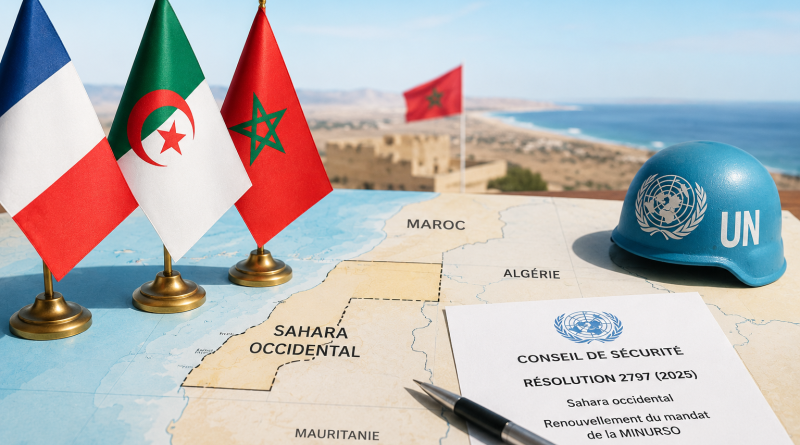
The United Nations framework has itself become a terrain of interpretation. Every resolution, every renewal of MINURSO, every reference to autonomy or political compromise is read as a gain or a retreat. That is why the language matters. In the Maghreb, a word can move a border before any map is changed.
The political lesson is hard: Paris can speak of balance, but its position no longer looks balanced. It is a strategic bet on Morocco, managed with Algeria through functional channels. The thaw is therefore real but controlled. It lowers the temperature without resolving the fire.
Sources used
- Sources used: Le Monde, Reuters, UN Security Council Resolution 2797 (2025).
- To verify before publication: official documents, figures, dates and legal qualifications where applicable.