
Mali: Security Council, Attacks and Information War
Recent attacks in Mali are not only military operations. They reveal a crisis of sovereignty in which each camp seeks to control territory, fear and the narrative of war.
The source file refers to condemnation by the United Nations Security Council after attacks in Mali. Before publication, the exact text, the dates, the places, the tolls and the attribution to armed groups must be checked. But the broader issue is already clear: in the Sahel, international language is never only language. It enters a battlefield where legitimacy is contested as fiercely as territory.
A condemnation is not a policy
A Security Council condemnation can name violence, express solidarity, and signal that attacks against civilians or security forces are not invisible. That matters. But it does not protect a village, reopen a road, restore trust in the state or prevent the next raid.
The gap between diplomatic language and military reality is one of the central features of the Malian crisis. Communiqués multiply while insecurity persists. Each actor then uses those communiqués for its own narrative. The authorities present them as recognition of the threat they face. Armed groups read them as proof that their actions have strategic visibility. External allies use them to justify their presence or to criticize rivals.
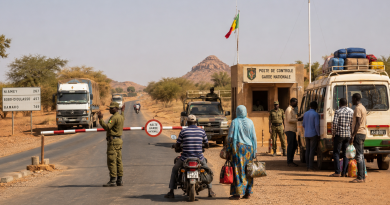
The population, meanwhile, often receives only the consequences: fear, displacement, checkpoints, interrupted markets, schools closed or emptied, and uncertainty over who controls what.
The ground against the narrative
The Malian state speaks of sovereignty. Armed groups speak of resistance, religion or local grievance. External actors speak of partnership, counterterrorism or influence. Each narrative tries to organize the same reality from above.
The ground is less obedient. It is made of shifting control, fragile alliances, local arrangements, retaliation, fear and survival. A village may be under state authority in the morning, under armed pressure at night, and under drone surveillance the next day. This is not only a military map. It is a social geography of insecurity.
That is why the information war matters. Naming the attacker, counting the dead, describing the target, reporting civilian casualties, recognizing abuses: each of these acts becomes political. In a conflict where access is limited and independent verification difficult, the battle over facts becomes part of the battle itself.
The UN in a diminished position
The UN’s role in Mali has been deeply reduced after years of tension and the end of the peacekeeping presence. That changes the meaning of Security Council language. The Council can condemn, but its capacity to observe, mediate and protect on the ground is limited.
This diminished position creates a vacuum. Regional authorities, military governments, foreign partners, armed groups and media networks fill it with competing accounts. The result is not silence, but noise: each side speaks loudly; the independent fact becomes harder to establish.
For journalism, this imposes discipline. No toll should be treated as definitive unless attributed. No armed responsibility should be stated without source. No official narrative should be confused with the whole truth. In Sahelian conflicts, imprecision is not a minor flaw. It can become propaganda.
Information war as a central front
The Malian war is fought through arms, but also through credibility. Who protects? Who betrays? Who kills civilians? Who defends sovereignty? Who serves foreign interests? Who controls the road, the village, the story?
Those questions matter because political authority in the Sahel is no longer secured only by institutions. It is constantly rebuilt through demonstrations of force and claims to legitimacy. A military government must show that it controls the territory. Armed groups must show that the state cannot. Foreign allies must show that they are useful. Rivals must show that they are dangerous.
This is why condemnation, even when justified, is insufficient. It names an event but not the mechanism that produces repetition.
The Sahel is not stabilized by communiqué
Mali will not be stabilized by statements alone. It requires security, but also justice, credible local administration, protection of civilians, economic life, roads, schools, and a political horizon that does not reduce society to obedience under war conditions.
The Security Council can condemn attacks. It cannot substitute itself for a social contract. Nor can any military alliance do so. Sovereignty that cannot protect ordinary people becomes a slogan. Counterterrorism that cannot distinguish civilians from combatants becomes another generator of fear.
The Malian crisis must therefore be read beyond the communiqué. The issue is not whether attacks should be condemned. They should. The issue is what that condemnation reveals: a state fighting for authority, armed groups fighting for space, external actors fighting for influence, and populations forced to live inside a war where even facts are contested terrain.
Sources used
- Press: Sahara Medias, source file on Security Council condemnation of attacks in Mali, to be checked before publication.
- Press/context: Le Monde Afrique and The Guardian on the Malian crisis in May 2026.
- To verify: official Security Council text, exact dates, places, tolls and attribution.