The rent in new clothes
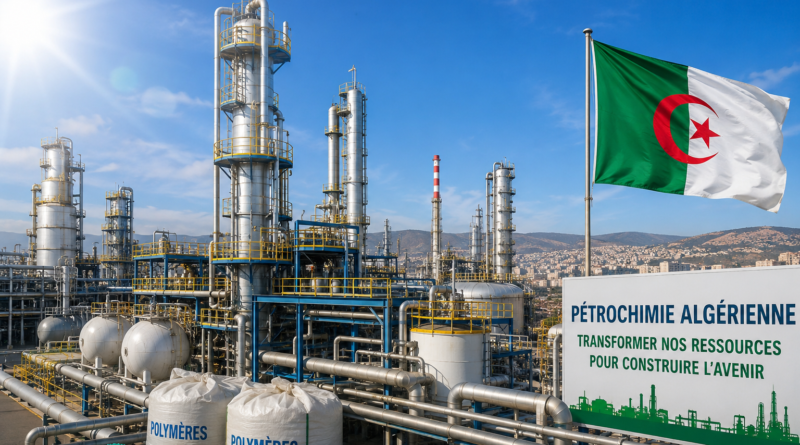
Algeria wants to turn petrochemicals into a tool of industrial sovereignty. But a transformed rent does not automatically cease to be a rent. Everything depends on what is built around the resource: plants, skills, qualified jobs, local subcontracting, technical knowledge, domestic outlets and public control over value.
According to the initial source, the Council of Ministers held on 18 May 2026 placed petrochemicals back at the centre of economic policy. The discussion reportedly focused on local resource valorisation, the use of oil to produce plastics, helium as a strategic high-value resource, and phosphate as part of a wider industrial policy. The stated objective is to reduce import dependence, transform more value locally and limit Algeria’s exposure to external shocks.
The argument is serious. A country that exports hydrocarbons while importing a large share of its plastic inputs lives with a classic contradiction of rentier economies: it sells energy and raw material, then buys back part of its own value after it has been transformed abroad. But diagnosing the contradiction is not enough. The real question is how the state intends to solve it.
Transformation does not always mean industrialisation
Petrochemicals can be a genuine industrial step. They can produce resins, fertilisers, technical plastics, solvents and components used in agriculture, construction, health care, packaging and manufacturing. They can also support a dense network of small and medium-sized firms in processing, maintenance, transport, engineering and recycling.
But they can also become a more sophisticated extension of the rent. That is the Algerian risk. If projects remain limited to capital-intensive complexes, dependent on imported equipment and foreign partners, weakly connected to local firms and mainly export-oriented, transformation will not alter the social structure of the economy. It will add another floor to the rent without building a dense national productive fabric.
The difference between the two models is concrete. How many qualified jobs are created? How many local companies gain access to subcontracting markets? What share of equipment is produced, maintained or repaired locally? What training centres accompany the projects? What links exist with universities, technical institutes, industrial zones and consumer needs? An industrial strategy is not judged by the size of its announcements, but by the productive network it forces into existence.
Reuters reported in October 2025 that Algeria planned 60 billion dollars of energy investment over five years, mostly in exploration and production, with a portion allocated to refining and petrochemicals. The same month, Reuters reported a 5.4 billion dollar production-sharing contract between Sonatrach and Saudi Arabia’s Midad Energy. These announcements confirm one point: the state still thinks its economic future through energy. The question is not whether Algeria invests. It does. The question is whether that investment shifts the centre of gravity of the economy or consolidates the same architecture.
Plastics as a social test
Producing plastic raw materials locally may reduce the import bill, secure supply and support local processors. But plastics are not socially neutral. They affect food packaging, agricultural inputs, household goods, industrial parts, medical devices, construction and ordinary daily life.
If petrochemicals merely replace foreign suppliers with a few large domestic operators, the social effect will remain limited. Prices may remain high, distribution concentrated, SMEs dependent and consumers exposed. Industry becomes popular only when it changes real access to goods, lowers costs, stabilises supply and opens durable jobs.
This is where official discourse must be taken seriously, but not literally. Industrial sovereignty does not mean replacing a foreign supplier with a local monopoly. It means collective capacity: producing, processing, repairing, recycling, training and directing uses. The rent always tends to concentrate decision-making. It prefers big projects, contracts, announcements and investment figures. Real industry requires patience: standards, quality, skills, logistics, energy, credit, land, public enterprise governance and a struggle against import rents.
The trap of simple substitution
Import substitution is necessary, but insufficient. It can become a convenient slogan. A country imports fewer finished goods and believes itself more sovereign. Yet it may import more machines, licences, technologies, spare parts and know-how. It may produce locally in form while remaining dependent in substance.
Three levels must therefore be distinguished. The first is commercial: reducing the import bill. The second is industrial: producing inputs, components and intermediate goods locally. The third is strategic: mastering technology, maintenance, training, innovation and the organisation of the sector. The Algerian debate must be located at the third level. Otherwise, petrochemicals will become a new name for an old dependency.
The environmental issue cannot be postponed either. Betting on plastics in a world that seeks to reduce some uses of plastic requires recycling, circular economy, health standards, industrial pollution control and waste management. A modern strategy cannot simply produce more. It must produce better, more cleanly and with a vision of use.
Algeria has assets: resources, energy experience, powerful public companies, a domestic market, industrial needs and a regional position. But a natural asset is not a policy. Gas, oil, phosphate and helium do not by themselves create an industrial fabric. They create a possibility. Politics begins when choices are made about who captures value, who works, who learns, who produces and who pays for mistakes.
Petrochemicals can become a step toward productive sovereignty. They can also become the modern form of an old reflex: believing that selling a resource better is enough to transform an economy. The rent knows how to change clothes. Real industry is recognised by something else: it expands society’s power to produce.
Yaqoub Mellali
Sources used
Press:
- El Watan, « Conseil des ministres : Tebboune insiste sur le développement de l’industrie pétrochimique », 18 mai 2026.
- Reuters, « Algeria plans $60 billion energy investment over five years, Energy minister says », 6 octobre 2025.
- Reuters, « Algeria signs $5.4 billion oil and gas deal with Saudi firm Midad Energy », 13 octobre 2025.