Sahel: proclaimed sovereignty is not enough to build regional security
The attack on Niamey airport, Malian sanctions against nationals in exile, the rise of the Alliance of Sahel States and Naftal’s mission in Niger compose one image: the Sahel is searching for a new sovereignty, but remains trapped in a crisis of security, legitimacy and capacity.
In the Sahel, every local event immediately becomes regional. The 18 June attack on Diori Hamani international airport in Niamey is not only a Nigerien security event. It touches a symbolic node: the capital, the airport, critical infrastructure, movement of people and goods, and the state’s ability to make authority circulate.
Nigerien authorities say the attack was carried out by assailants they present as linked to France. They announced a toll: thirteen dead on the Nigerien side, including eleven members of the defence and security forces and two civilians, twenty-two attackers neutralized, suspects arrested and weapons recovered. Other sources indicate that the attack was claimed by Al-Qaeda’s Sahel branch. The distinction is essential: the established fact is a deadly attack against the airport; the political attribution to a foreign power is a statement by the authorities and requires proof, verification and caution.
Caution does not prevent analysis. It makes it serious. The Sahel has become a space where military-led states try to consolidate legitimacy through the vocabulary of sovereignty. Niger, Mali and Burkina Faso, gathered in the Alliance of Sahel States, want to break with old tutelage, reduce dependence on Paris, build their own security cooperation and impose a narrative of emancipation. This dynamic is real. It corresponds to a historical rupture with the postcolonial Francophone order.
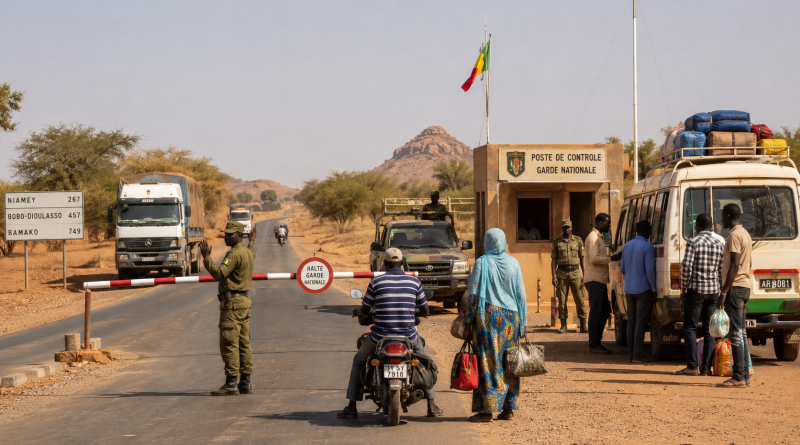
But proclaimed sovereignty does not govern chaos. A state can expel foreign forces, denounce interference, rename alliances and multiply patriotic communiqués. None of this replaces territorial intelligence, justice, local administration, popular trust, rural economy, roads, public services or governed borders. The Sahel is not short of strong words. It lacks durable capacity.
Mali illustrates this brutally. Bamako ordered targeted financial sanctions against twelve Malians abroad, accused in particular of promoting or supporting terrorism. Among those targeted are opponents, journalists, activists or political actors in exile. The established fact is the freezing of assets and economic resources for a renewable period. The political reading is that the anti-terrorism instrument also becomes a tool to control opposition outside the country. The line between national security and political neutralization becomes dangerously porous.
Algeria should look at the Sahel with lucidity. It cannot limit itself to ritual condemnations of attacks or diplomacy of principle. Its Sahelian depth is historical, geographical and strategic. Naftal’s mission in Niger may be useful if it leads to infrastructure, energy services, LPG, bitumen, logistics and concrete partnerships. The Sahel will not be stabilized only by summits. It will be stabilized by roads, available fuel, jobs, markets, schools, healthcare, administered borders and legal economic circuits.
The great mistake would be to read the AES as a simple ideological bloc, either to applaud automatically in the name of anti-imperialism or to condemn mechanically in the name of the old regional order. The AES is at once a rupture, an attempt, a symptom and an uncertainty. It exPresss a Sahelian will for autonomy and reveals the collapse of ECOWAS as the uncontested framework. Its future will depend on a material question: can the juntas transform legitimacy of rupture into institutions able to last?
For Algeria, the challenge is precise. It must avoid believing itself naturally central simply because it is vast, neighboring and endowed with diplomatic memory. It must also avoid retreating into powerless prudence while other actors shape the ground. A Sahel policy worthy of the name cannot be only security-based. It must be economic, territorial, cultural and social.
The Sahel requires long thinking. No French nostalgia, no romanticism of uniforms, no slogans of sovereignty without bread, no cooperation reduced to apparatuses. Real Sahelian sovereignty will be the sovereignty that protects populations, controls roads, moves goods, opens schools, gives youth a horizon and makes law stronger than fear. Everything else is a flag waved in the dust.
Mourad Ighil
Sources used
- Press : BBC Afrique, “Le Niger accuse la France d’être à l’origine de l’attaque de l’aéroport de Niamey”.
- Press : Le Sahel Niger, communiqué du ministère de la Défense nationale.
- Press : RFI Afrique, “Mali : sanctions financières ciblées contre douze ressortissants en exil”.
- Press : MaliActu, “Afrique de l’Ouest en ébullition”.
- Press : Algérie Eco, “Naftal en mission au Niger”.