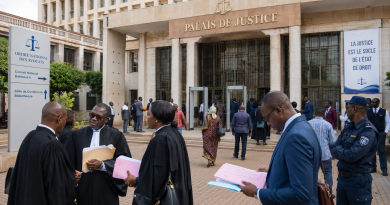

Justice under mission
In Niger, the justice minister has announced a refoundation of the judiciary. The word is heavy. It must be measured not by reform language, but by concrete guarantees for citizens, detainees and judges.
According to Le Sahel Niger, the minister of justice and human rights, Alio Daouda, presented his record on national public broadcasting and outlined reforms intended to restore dignity to Niger’s judiciary. The diagnosis is familiar: slow proceedings, uneven territorial court coverage, too few judges and clerks, insufficient judicial and prison infrastructure, a perception of corruption, and limited access to justice for citizens.
The minister put forward figures: 534 judges, 425 clerks, 55 ordinary courts, three courts of appeal and 70.5 percent judicial coverage. He also said the system processes roughly 7,500 cases out of 9,000 to 10,000 registered each year. These figures must be checked against complete administrative documents. But they already show the frame of the problem: it is not only moral, it is material. A vast country with limited judicial staff cannot produce fast, accessible and equal justice without means, territorial coverage and control over practices.
The decisive question remains: what does it mean to refound justice under a transitional regime?
Numbers cannot replace guarantees
The administrative temptation is to treat justice as a case-processing machine. One counts registered cases, processed cases, courts, ratios of judges, deadlines and digital platforms. All this matters. Slow justice can become permanent injustice. A procedure that lasts too long damages evidence, exhausts litigants, extends detention, encourages arrangements and feeds distrust.
But justice is not only a flow-management system. It is an institution of limits. It limits the state, the police, prosecutors, private power and even the legitimate anger of public opinion. When judicial refoundation is discussed, the first criterion is therefore not speed. It is the guarantee.
A case can be processed quickly and still be unjust. A digital hearing can be opaque. A simplified procedure can become summary justice. A guilty-plea procedure may relieve overloaded courts, but it requires strict control of consent, legal assistance, proportionality and the absence of pressure on defendants. Without these safeguards, speed becomes a surrender of rights.
The minister mentioned reforms of the criminal code, criminal procedure, nationality law, conciliation and arbitration, the extension of guilty-plea procedures, and online delivery of some documents such as criminal records. These tools may improve access to law. They may reduce queues and bring justice closer to remote citizens. But they must be read through one cold question: who controls their use?
Independence is not an administrative favour
The most revealing part of the ministerial record concerns judicial independence. According to Le Sahel, the minister criticised a view of independence that would turn the judge into a free electron accountable to no one. He recalled that a judge remains a state official, trained, assigned and paid by the state, while also saying that independence applies when deciding cases.
The point deserves attention. A judge is not irresponsible. Judges may be subject to ethical duties, residence rules, professional discipline and integrity requirements. Judicial independence never meant corporate immunity. It protects neither laziness, nor corruption, nor abuse.
But judicial independence cannot be reduced to permission granted at the moment of judgment. It requires conditions: appointment, career, discipline, transfer, protection against pressure, personal security and the ability to rule against the state when the law requires it. If the judge is first described as a state official, the risk is clear: justice may be thought of as an extension of the executive, not as a limit upon it.
This is where the language of refoundation becomes either dangerous or promising. Promising if it rebuilds an institution that is closer, more transparent and more accountable. Dangerous if it is used to bring the judiciary to heel by presenting it as disorderly, corporatist or insufficiently aligned. Reform of the judiciary must therefore be judged by mechanisms, not by stated intentions.
Detention is the real human rights test
The minister himself identified detention as the hard core of human rights. That is correct. Justice is judged first by what it does to confined bodies: length of pretrial detention, access to lawyers, appearance before a judge, material conditions, medical care, family contact, effective remedies and inspection of detention sites.
In Niger, this question cannot be abstracted from the post-July 2023 coup context. Associated Press reported in April 2025 that several officials detained after the coup had been released, while former president Mohamed Bazoum remained in custody. Reuters reported in June 2024 that Bazoum’s lawyers criticised violations of defence rights after the lifting of his immunity. These elements do not summarise the whole Nigerien justice system. But they prevent judicial refoundation from being treated as a purely technical file.
A state may reform its codes while leaving sensitive detentions in a grey zone. It then modernises part of its apparatus while maintaining an exception at the centre of the system. The rule of law is not measured by easy cases. It is measured where power has an interest in weighing on the judge, slowing defence, isolating a person or turning procedure into a political instrument.
To refound is to accept being controlled
The minister also spoke of corruption and zero impunity. The principle is sound. Judicial corruption destroys more than a decision: it destroys the minimum belief that the poor, the weak or the opponent can still obtain justice against someone more powerful. It turns the court into a market.
But the fight against corruption must not become a selective weapon. It must target practices, not opponents; evidence, not reputations; procedures, not rumours. It requires independent investigations, reasoned decisions, public sanctions, remedies and protection for whistleblowers. Without that, the word corruption can discipline judges as much as it can clean up the institution.
Niger needs a justice system that works. Citizens do not live on legal abstractions. They need documents delivered, disputes settled, detainees brought before judges, judgments enforced, judges present, clerks available and prisons inspected. But functioning justice is not merely fast justice. It is justice capable of saying no.
Refoundation will begin when justice is no longer presented only as a government project, but as a legal limit that can be invoked against government.
Yamina Boudiaf
Sources used
Press:
- Le Sahel Niger, “Redevabilité des membres du gouvernement : Le ministre de la Justice présente son bilan et annonce une refondation de l’appareil judiciaire”, 18 May 2026.
- Associated Press, dispatch on releases of officials detained after the Niger coup and the continued detention of Mohamed Bazoum, 2 April 2025.
- Reuters, dispatch on the lifting of Mohamed Bazoum’s immunity and his lawyers’ criticism of defence-rights violations, 14 June 2024.