Regroupment Camps: The Colonial Archive That Will Not Pass
Regroupment camps remind us that colonial war was not fought only in maquis or prisons. It was also fought through the forced organization of space, families and rural life.
To speak of the camps is to move away from the comfortable image of war as a sequence of battles. It is to enter a more administrative, colder and more durable violence: the displacement of populations, the concentration of families, the surveillance of villages, the interruption of agricultural cycles and the dismantling of the ordinary geography of rural Algeria.
This is why the subject cannot be treated as an archival curiosity. The camps were not secondary scenery around the war. They were one of the ways in which colonial power sought to separate rural populations from the insurgency, but also from their own forms of life. The aim was military; the effect was social. Villages were emptied, families were moved, land was abandoned, relationships with water, fields, herds and burial places were fractured.
To move, to watch, to break
The first violence of the camps lies in the verb “to regroup”. The word sounds technical, almost administrative. It hides a brutal reality: people were uprooted from the places where their lives had meaning. A rural world is not only a set of houses. It is a network of paths, wells, gardens, kinship, seasonal work, local authority, memory and burial.
When that world is displaced, the wound is not only material. It touches time itself. The family no longer lives where its dead are buried. Children no longer learn the same paths. Work rhythms are interrupted. The link between land and subsistence is weakened. Surveillance replaces familiarity.
Colonial administration often presented such measures under the language of security, modernization or protection. That vocabulary must be read against the grain. Protection imposed by an army that displaces people is not neutral protection. Modernization that begins by destroying local autonomy is not neutral modernization. Security that requires the confinement of the colonized is a politics of domination.
Modernization under constraint
The camp can always be re-described by power as order: roads, clinics, schools, visibility, census, access. But the question is never only what was built. It is what was destroyed in order to build it, and who decided.
Colonial power often claimed to bring administration to spaces it considered opaque. In reality, opacity was also another name for autonomy. The rural world had its own forms of organization, mediation and memory. By regrouping populations, colonial authority made them more legible to the military and the administration. It made them easier to count, control and discipline.
This is where memory matters. If the camps are reduced to an episode of counterinsurgency, their social meaning disappears. If they are remembered only as hardship, their political meaning is diluted. They were both: an instrument of war and a machine for remaking the rural order under colonial command.
The memory of the rural world
The Algerian national narrative often remembers the maquis, the martyr, the prisoner, the fighter and the militant. It must also remember the displaced peasant, the uprooted family, the child raised inside a controlled perimeter, the woman forced to reorganize survival in a camp, the village emptied of its density.
These memories are fragile because they do not always leave spectacular documents. They live in family stories, silences, place names, inherited fears and the altered geography of villages. They are archives without shelves. That is precisely why they must be taken seriously.
The regroupment camps also force a question about the rural foundation of Algerian memory. The war was not only an urban or military event. It transformed land, villages, agriculture and kinship. To ignore that is to amputate the memory of the war from one of its deepest social sites.
An archive against comfortable forgetting
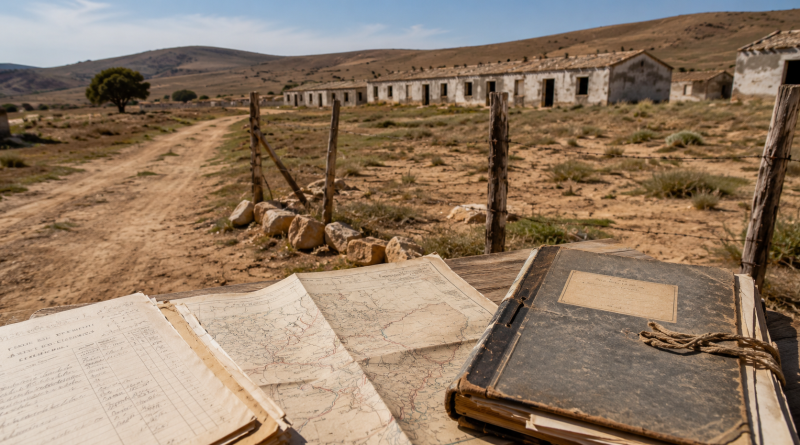
The return of the camps to public discussion is important only if it does not become commemorative decoration. Memory is not served by a quick moral gesture. It requires precision: figures, places, decisions, chains of command, testimonies, maps, administrative language and its violence.
But precision must not be used to cool the subject until it becomes harmless. The point is not to accuse blindly. It is to understand structurally. The camps show a colonial system that did not merely occupy territory; it reorganized life itself in order to govern it.
That is why this archive will not pass quietly. It disrupts the idea of a war limited to armed confrontation. It reveals a war against the conditions of rural existence. It says that domination is also made of registers, fences, transfers and imposed waiting.
Remembering the regroupment camps is not reopening an old wound for the pleasure of grievance. It is naming a mechanism. A people is not only conquered when its army is defeated. It is also attacked when its villages, paths, fields and family rhythms are made governable by force.
Sources used
- Press: France 24 Afrique, source file on regroupment camps in Algeria, to be checked before publication.
- Press/context: Le Monde, March 17, 2022, on work devoted to the regroupment camps.
- To verify: academic sources, figures and archival references before publication.