Tsamiya-Kamba: a border reopens without reconciliation
The resumption of traffic through the Tsamiya-Kamba corridor has been presented as a regional reopening. It is above all a logistical compromise: trucks move again, commerce breathes, but the Niger-Benin border remains an unresolved political and security file.
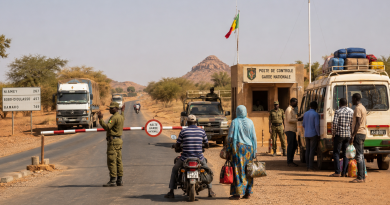
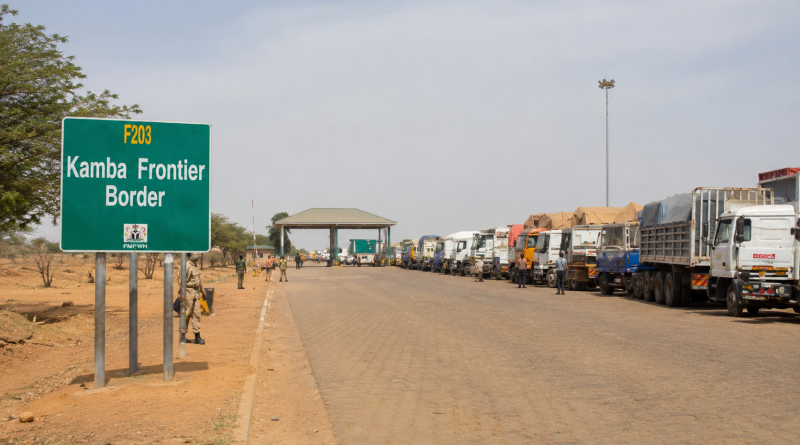
In early February 2026, Nigerian authorities reopened the Kamba crossing in Kebbi State, allowing the resumption of freight transit towards Niger through the Tsamiya-Kamba axis. Several regional and international press sources referred to more than 1,600 blocked trucks, sometimes nearly 2,000 depending on the wording, loaded with goods bound for the Nigerien market. The detail matters: this is not a general reconciliation between Niamey and Cotonou, nor a full normalisation of the Niger-Benin border. It is first of all a commercial corridor reactivated through Nigeria.
That distinction is not secondary. It is the heart of the matter. In West Africa, the words “open border” and “closed border” often conceal more complex realities: tolerated crossings, bypassed routes, managed corridors, maintained political restrictions, discreet customs negotiations. Tsamiya-Kamba belongs to that grey zone. Movement resumes because the economy requires it, but political distrust remains.
A logistical reopening, not diplomatic peace
Since the July 2023 coup in Niger, relations between Niamey and several neighbours have been reshaped by regional sanctions, security accusations, the rupture with ECOWAS and the construction of the Alliance of Sahel States. Benin occupies a particular place in this crisis. Cotonou has sought to preserve its economic role, notably through the port of Cotonou, an important outlet for landlocked Niger. Niamey, for its part, has maintained a security and political reading of the border, accusing Beninese territory of being associated with threats to its stability. These accusations must be attributed as such: they are the Nigerien position, not an independently established public fact.
The resumption of the corridor therefore does not settle the dispute. It bypasses it. Nigeria, the region’s demographic, economic and customs heavyweight, once again becomes a material arbiter. By reopening Kamba, Abuja enables Niger to access immobilised cargo, allows Benin to ease part of the transit pressure, and lets its own customs services regain control over a profitable commercial flow. This decision does not erase the crisis; it makes it administrable.
That is what must be read politically: when official diplomacy stalls, logistics imposes its necessities. States may proclaim rupture, but markets, hauliers, ports and consumers remind them that regional economies are intertwined. Niger may harden its sovereignist discourse; it still depends on external corridors for part of its supply. Benin may reopen or wish to reopen; it does not alone control Niamey’s decision. Nigeria may present itself as a facilitator; it is also acting for its own security, revenues and border influence.
Trade as a revealer of dependence
The Tsamiya-Kamba file exposes a classic contradiction of landlocked Sahelian states: political sovereignty is proclaimed from capitals, but material sovereignty is played out in ports, customs posts, roads and border areas. Niamey may break with a regional organisation or harden its relations with Cotonou; supplies still have to move. Flour, rice, manufactured goods, inputs and consumer products do not wait for diplomatic disputes to be resolved.
This is not an argument against Nigerien sovereignty. It is a blunt reminder: no sovereignty can last if it does not control its logistical dependencies. In the Sahel, formal independence remains shaped by landlocked geography, inherited infrastructure, neighbouring ports, private transport networks, customs decisions and security power balances. A border is not only a line. It is an economic machine.
The ECOWAS-AES crisis sharpens this tension. On 29 January 2025, Mali, Burkina Faso and Niger formally left ECOWAS. Politically, the rupture confirmed the distancing of three military-led regimes from a regional organisation they accused of alignment and hostility. Materially, it did not abolish exchanges, migration, transit needs or the economic solidarities forced by geography. States can leave an institutional framework; they do not leave their neighbourhood.
This is why the resumption of the corridor should not be read as a mere transport fact. It signals the return of economic reality at a time saturated with verbal sovereignism. Private operators, hauliers, traders and consumers directly bear the cost of border standoffs. Blocked goods are not abstractions: they become losses, delays, price rises, supply shortages and social tensions.
The border under security pressure
The other dimension of the file is security. The Benin-Niger-Burkina axis, especially around W Park and the contact zones between states, remains exposed to the expansion of armed groups operating in the Sahel. In January 2025, international press reported a deadly attack against the Beninese army in the north of the country, attributed by the cited sources to GSIM/JNIM. That reality weighs on every border decision. No state in the area now thinks about circulation without associating it with the risks of infiltration, smuggling, armed taxation or attack.
But security can become an elastic argument. It justifies reinforced controls, sometimes necessarily. It can also be used to prolong a political closure, delegitimise a neighbour or regain control over economic flows. The difficulty lies there: distinguishing the real threat from its diplomatic use. In the Niger-Benin case, this distinction is essential. Risks in the area are documented; precise accusations between states must remain attributed and verified.
Tsamiya-Kamba therefore functions as a controlled valve. Trade resumes, but within a monitored framework. Trucks pass, but trust does not pass at the same pace. Customs officers talk faster than chancelleries. Economies need openness; security apparatuses demand guarantees; political authorities want to save face.
De-escalation without settlement
It would be tempting to see this reopening as a sign of a return to normal. That would be too quick. Normality has not really existed in this region since the succession of coups, the withdrawal of French forces from several Sahelian countries, the ECOWAS-AES rupture, the rise in armed violence and the competition between external powers. What exists are arrangements. Partial compromises. Doors reopened without declarations of peace. Corridors that say quietly what political speeches sometimes refuse to admit: no state can live durably in the asphyxiation of its own borders.
For Niger, the resumption of Tsamiya-Kamba loosens a supply constraint without formally conceding on the dispute with Benin. For Benin, it confirms that the port of Cotonou remains a regional tool even when the political relationship with Niamey deteriorates. For Nigeria, it strengthens a pivotal position: Abuja can reopen, filter, arbitrate, secure and capture part of the customs value.
The regional lesson is clear. Sahelian sovereignty will not be decided only at summits, in communiqués and through spectacular ruptures. It will be decided by the ability to secure roads without suffocating populations, diversify corridors without creating new dependencies, and control borders without turning every neighbour into a permanent threat.
Tsamiya-Kamba does not close the Niger-Benin crisis. It shows its current form: a crisis serious enough to prevent political normalisation, but not manageable enough to do without commerce. Within this contradiction, the corridor reopens as borders often reopen in times of distrust: out of necessity, under surveillance, without reconciliation.
Mourad Ighil
Sources used
- Anadolu, “Niamey et Abuja officialisent un corridor pour le transit des marchandises débarquées au port de Cotonou”, 12 February 2026.
- ActuNiger, “Réouverture du corridor frontalier Tsamiya-Kamba”, 10 February 2026.
- Mondafrique, “La route Bénin-Niger ouverte à 1600 camions via le Nigeria”, 11 February 2026.
- ISS Africa, “Nigéria-Niger-Bénin : reprise des échanges sous menace sécuritaire”, 30 April 2026.
- Reuters, “West Africa bloc announces formal exit of three junta-led states”, 29 January 2025.
- Le Monde, January 2025 articles on the ECOWAS-AES rupture and the security situation in northern Benin.