Sovereignty on Display
Modernized ports, billions announced for energy, a migration standoff with Paris: Algeria is staging a more assertive sovereignty. But sovereignty is not a display window. It is measured on quays, in pipelines, in value chains, in international agreements, in administrations, and in the dependencies a state is able, or unable, to loosen.
Algeria likes to speak of sovereignty. The word is central to the state’s language: economy, energy, diplomacy, memory, relations with France. That is not false. A country that emerged from a colonial war cannot treat sovereignty as an abstraction. But there is sovereignty as proclamation, and sovereignty as capacity. The first is stated in communiqués. The second is tested in ports, factories, rail networks, energy contracts, negotiating margins and the country’s productive strength.
This is where the Algerian moment becomes revealing. On paper, several signals point in the same direction: port modernization, major Sonatrach investment plans, a stated will to revise the association agreement with the European Union, and a refusal to be trapped by the French debate over the 1968 migration agreement. The official language is one of taking back control. The problem is that this takeover meets a basic question: what is sovereignty worth if it still depends heavily on rent, external markets, imported technology and poorly mastered logistics corridors?
Ports, the material truth of the state
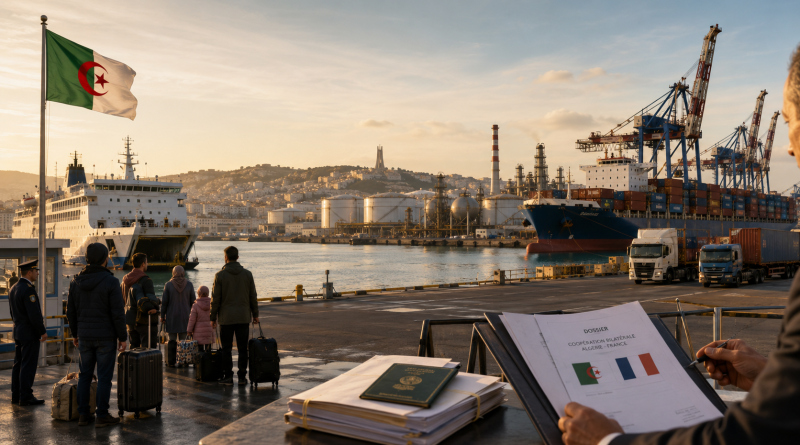
A port is never merely an infrastructure. It is an economic border, a control apparatus, a place where the state meets global trade. In a country that still imports much of its equipment, inputs and some essential goods, port sovereignty is not secondary. It determines delays, costs, the smoothness of foreign trade, the ability to export more than hydrocarbons, and the real possibility of becoming a regional transit space.
Announcements of port investment should therefore be taken seriously, but not literally as achievements. Modernizing quays, connecting ports to rail, reducing customs bureaucracy, improving logistics and securing flows is not only construction. It is another way of governing. Algeria can expand its port capacities. But if ports remain clogged by administrative slowness, monopolies, opaque arbitration or the absence of an export-oriented productive fabric, modernization will remain a showcase.
The port of Béjaïa, whose exports reportedly rose sharply at the beginning of 2026 according to economic press reports, gives a useful sign: margins exist. But a temporary increase does not transform the model. The question is not whether Algeria can export more in a few segments. It is whether it can turn ports into tools of a coherent productive policy: local industry, processing, added value, exporting firms, standards, finance and inland transport. Without that, the port mainly serves to administer dependency.
Energy gives weight, not autonomy
Sonatrach remains the material heart of the Algerian state. The 2026-2030 plan, presented around exploration, refining, petrochemicals and local processing, responds to an obvious need: renewing reserves, preserving export capacities, reducing some imports and capturing more value at home. In a world where Europe seeks to reduce its dependence on Russian gas and diversify supply, Algeria has a real lever.
But that lever has limits. Energy gives diplomatic weight; it does not automatically produce economic autonomy. Rent finances the state, buys social peace, supports imports and sustains major budgetary balances. It does not, by itself, create a diversified economy. It can even delay transformation when it creates the illusion that sovereignty is already secured because the underground still pays.
Petrochemicals and refining are serious paths. They nevertheless raise a political question: who controls added value? Who masters the technologies? Who supplies the equipment? Who captures the markets? Who decides priorities between gas exports, domestic consumption, industrialization, energy transition and social needs? As long as these questions remain trapped in narrow circles of the apparatus, energy sovereignty remains vertical. It comes from the state and descends toward society, but does not necessarily transform the real country.
Algeria does not lack resources. It lacks a durable passage from rent to production. That passage cannot be decreed. It requires solid economic institutions, firms able to move up the value chain, technical education, applied research, efficient ports, reliable commercial justice and an administration that does not strangle initiative in the name of control.
The 1968 agreement, a Franco-Algerian stage
The Franco-Algerian migration dossier reveals another side of this strained sovereignty. The agreement of December 27, 1968, which regulates the movement, residence and employment of Algerian nationals in France, has again become a battlefield in French politics. On October 30, 2025, the French National Assembly adopted a resolution calling for the denunciation of that agreement. Precision matters: a parliamentary resolution is not the automatic legal denunciation of a bilateral agreement. It has political weight, not immediate operational force.
But the symbol is enough to shift the balance of power. In Paris, the 1968 agreement serves as a convenient target in a migration policy obsessed with displaying firmness. In Algiers, it is presented as a sovereign file, a bilateral legacy that France cannot handle at will. Each state performs before its own public. France wants to show that it is taking back control of its borders. Algeria wants to show that it does not yield to the former colonial power’s injunctions.
The problem is that both states speak of sovereignty while using migrant bodies as diplomatic instruments. Consular laissez-passer, removals, visas, residence statuses, diplomatic passports: everything becomes a bargaining chip. The ordinary citizen disappears behind the apparatus. Student, worker, family member, binational, undocumented migrant, pensioner: all are caught in a machine where law becomes a lever of pressure.
For Algeria, the file is uncomfortable. It can reject French pressure, but it cannot ignore that the mobility of its nationals remains tied to an inherited bilateral mechanism. It can denounce French instrumentalization, but it cannot reduce migration to a matter of national honor. When part of the youth seeks elsewhere what the national economy does not provide, the problem is not only diplomatic. It is social, productive and political.
Europe, partner and constraint
The same paradox appears with the European Union. Algiers wants to revise the association agreement that entered into force in 2005, citing commercial and industrial imbalance. The criticism is serious: trade opening did not produce the promised diversification. It often consolidated an asymmetric relationship in which Algeria mainly exports energy and imports processed goods, equipment, technologies and consumer products.
But requesting a revision is not enough. In 2025, the European Union initiated a dispute-settlement procedure against Algeria over trade and investment restrictions. Again, the conflict reveals a structural tension: Algiers wants to protect its market, support production and control imports. Brussels defends the rules of an agreement it considers binding. Behind the legal language lies a battle over the right to industrial development.
The issue is therefore less whether Algeria should stand up to Europe than with what tools it does so. Import restrictions can offer temporary protection. They can also fuel shortages, administrative rent, favoritism and opaque circuits if they are not accompanied by a real productive strategy. Sovereignty does not mean closing for the sake of closing. It means producing what one claims to substitute, training, financing, exporting, controlling monopolies and accounting for choices.
Power prefers administered sovereignty
The common thread between ports, energy, migration and Europe is this: Algeria has strong political sovereignty, but unfinished productive sovereignty. The state knows how to say no. It knows how to block, slow, negotiate, suspend and centralize. It knows how to turn sovereignty into a posture of resistance. But it still struggles to turn it into a distributed social capacity.
Real sovereignty cannot be limited to the apparatus. It requires ports that serve producers, energy that finances transformation, migration that ceases to be an exit valve for youth, international agreements renegotiated with a clear industrial project, and citizens who are not mere spectators of a diplomacy whose consequences they bear.
The Algerian regime likes to oppose national dignity to external pressure. That dignity is necessary. But it becomes fragile when it hides internal dependencies: rentier economy, bureaucratic heaviness, weak production, excessive centralization, and lack of transparency in major choices. Sovereignty is not proven only against Paris or Brussels. It is proven before Algerians, in their work, their infrastructure, their mobility, and their ability to live without the gas price deciding their future.
The sovereign showcase is visible. The dependencies are in the cables, the quays, the contracts, the visas, the turbines, the missing rail links and the absent value chains. That is where the real balance of power is decided.
Karim Medjani
Sources used
- Assemblée nationale française : séance du 30 octobre 2025 sur la proposition de résolution visant à dénoncer les accords franco-algériens de 1968.
- Dalloz Actualité : analyse de la résolution adoptée le 30 octobre 2025 sur les accords franco-algériens.
- Le Monde : couverture de la crise franco-algérienne autour de l’accord migratoire de 1968.
- APS : informations sur le plan d’investissement Sonatrach 2026-2030.
- Agence Ecofin / La Tribune Afrique : données sur le plan de développement de Sonatrach et le contentieux UE-Algérie.
- Commission européenne, Access2Markets : Accord d’association UE-Algérie.
- TSA Algérie et Maghreb Emergent : informations économiques sur les investissements portuaires et les exportations via les ports algériens.