
The granary under suspicion
In Mali, the Office du Niger is not an ordinary agricultural administration. It is an infrastructure of sovereignty. Financial irregularities reported in such a strategic perimeter therefore do not concern public accounting alone. They raise a harder question : how does the state protect, or weaken, its own granary?
According to an article published by MaliActu on 18 May 2026, significant financial irregularities were reportedly denounced at the Office du Niger, with the matter referred to prosecutors. At this stage, caution is not stylistic. It is mandatory. The primary document, the amounts involved, the period under review, the departments concerned and the institutional responses must all be checked before any definitive legal or political qualification is made.
Control over water is social power
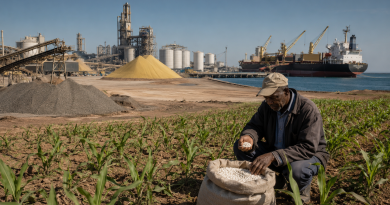
The Office du Niger is not just a technical legacy. It is a historical construction where the state, the river, land, farmers, planners, donors, investors and the very idea of food security meet. Its importance lies there : it organizes a material relationship between water and production. In a Sahelian country, that relationship is never neutral.
Water flowing through a canal is not only a natural resource. It becomes an administrative decision. It can open or block a farming season. It can provide access to land, fees, debt, yield and markets. In that chain, even limited accounting opacity produces more than a financial problem. It creates mistrust around the concrete distribution of the means of production.
If the reported irregularities are confirmed, the central question will be this : who really controls the value produced by irrigated land? Producers, administrators, intermediaries, companies, political networks, suppliers, project managers? Official language often speaks of food sovereignty. The field forces us to speak of power relations.
Rice alone does not make sovereignty
States like agricultural figures because they offer a simple image of strength : developed hectares, tons produced, higher yields, successful campaigns. But food sovereignty is not measured by irrigated acreage alone. It is measured by a country’s ability to organize production, protect producers, control costs, distribute water, monitor accounts and prevent rent-seeking from forming inside the very institutions meant to feed the country.
This is the contradiction of the Office du Niger. It is presented as a lever of food security, but it is also a possible space of rent. Where there is access to land, fees, public works, canal maintenance, inputs, public procurement, funded projects and promises of expansion, there is also a possibility of capture. That possibility does not mean guilt. It means public control must be stronger, clearer and traceable.
An audit or a judicial referral, if confirmed, solves nothing by itself. It merely opens a scene. The real test comes later : publication of verifiable elements, right of reply, distinction between administrative error and offence, protection of whistleblowers if there are any, prosecution of established responsibilities, recovery of undue sums if applicable, and reform of decision circuits.
Anti-corruption must not become a factional weapon
In Mali, as elsewhere, the denunciation of wrongdoing can serve two opposite purposes. It can open democratic control, or it can become a tool of political sorting. The same report can enlighten society or crush an opponent. The same prosecutor can defend the public interest or send a signal of discipline. The difference is not found in anti-corruption rhetoric. It is found in procedure.
Who investigates? According to what method? Which documents are published? Who is heard? Can those named respond? Are responsibilities individualized, or dissolved in general language? Are judicial consequences followed through, or merely announced at the useful moment? These questions are less spectacular than figures, but they are decisive.
In an institution as strategic as the Office du Niger, corruption, if demonstrated, is not only a moral fault. It is a levy on an infrastructure of survival. Every franc misallocated in an irrigation system can mean a canal left unrepaired, a less productive plot, an additional burden for a farmer, a delayed season, and a longer dependence on imports. Mismanagement is never abstract. It ends in the price of rice, in peasant debt, in household fatigue and in national vulnerability.
Governing the granary is not proclaiming it
Mali, like many Sahelian states, speaks of sovereignty for understandable reasons. The constraints are real : insecurity, landlocked geography, trade dependence, climate pressure and regional instability. But sovereignty cannot be decreed against the outside world if value leaks from within. It is not enough to denounce international pressure, world markets or old structures of domination. One must also look at administrations, contracts, offices, procurement rules, appointments and controls.
The Office du Niger should be a place of material truth : land, water, rice, labor, rural families. If financial irregularities are confirmed there, they should not be treated as a peripheral accident. They should be read as a warning about the fragility of sovereignty policies when they are not backed by robust governance.
Food sovereignty is not a speech. It is clean accounting, a maintained canal, a secured plot, a fairly paid farmer, a controlled public contract and published information. A state that wants to feed its people must first prevent its granary from becoming a rent for those who administer it.
Yaqoub Mellali
Sources used
Press:
- MaliActu, « Mali : irrégularités financières à l’Office du Niger », 18 mai 2026.
- Le Monde, « Mali : Choguel Maïga, de premier ministre complaisant à cible des putschistes », 8 janvier 2025.
Sources contextuelles :
- Données contextuelles sur l’Office du Niger et le barrage de Markala, à consolider par sources institutionnelles avant publication définitive.