
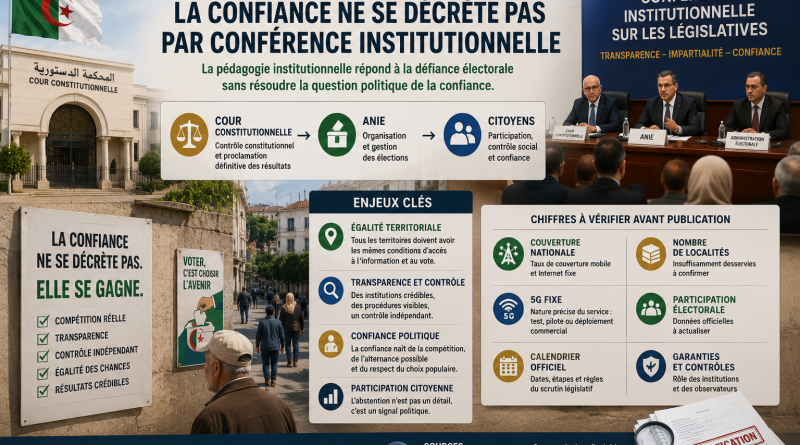
Legislative elections: trust cannot be decreed by institutional conference
When institutions explain themselves, they recognize that trust is no longer automatic. But explanation does not replace political confidence. In the electoral field, procedure can clarify the rules without resolving the crisis of belief.
What the fact reveals
The relationship between citizens and elections in Algeria cannot be reduced to technical administration. Voter lists, courts, appeals, campaign financing and oversight matter. But they operate inside a wider political memory shaped by distrust, abstention and the perception of controlled competition.
Institutional conferences seek to reframe the question. They present law, competence, deadlines and guarantees. This is necessary. A system without procedure is arbitrary. But a system that relies only on procedure risks mistaking formal explanation for legitimacy.
The political point
The ANIE and the Constitutional Court occupy decisive places in this architecture. Their credibility depends not only on what they say, but on whether citizens believe that competition is real, disputes can be heard, and results are not merely administered.
The problem is therefore structural. The state can organize elections. It can explain elections. It can secure elections. But it cannot decree confidence in elections if society sees the political field as already narrowed before the campaign begins.
This is the hard limit of institutional pedagogy. It can reduce confusion. It cannot produce consent by itself. Electoral trust is not born in a conference room. It is built when the rules are strong enough to allow uncertainty.
Sources used
- Sources used: El Watan archive source, ANIE and Constitutional Court documents to verify.
- To verify before publication: official documents, figures, dates and legal qualifications where applicable.